 Women of Life: Strength and Vision in Mostar By Danielle Bonner
Have you ever met a person and sensed there is something special about them? Since joining the NCCWN Donegal Women’s Network advocating for women’s rights and equality I have had the privilege of meeting inspirational women who have opened my eyes to the strength and vision of women all around the world. What I have come to find fascinating is the unique life story every woman holds. I have as one friend would say found my gender lens!
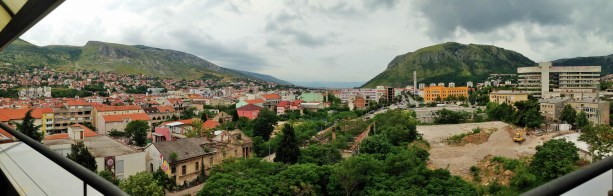
This summer I travelled to Mostar in Bosnia and Herzegovina (BiH), Mostar is one of the largest and culturally diverse cities in BiH with a population of 113,169[1] and a city that experienced great devastation during the country’s 1992-1995 war. While the war ended with the signing of the Dayton Peace Agreement in 1995 Mostar however remains a city with great ethnic divisions, the city can be seen to be divided into two halves with Croats predominately residing on the west side and Bosniaks (Muslims) residing on the east side.
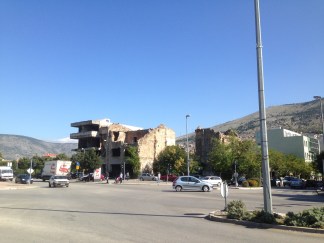 It can be easy when you arrive in Mostar to become focused on the multiple post conflict development issues like when I first visited in 2013 and the first thing that struck me was the multiple damaged or destroyed buildings avid remaining visions of the conflict. On this visit however I had the opportunity to live with locals and engage in conversations on a one to one level.
 For four weeks I stayed in the family run Hostel Nina Mostar on the east side of the city where I met the very cheerful and lovely owner Jadranka or as everyone calls her (Beba). One night in conversation with her she remarked that she had a mixed marriage which in Mostar meant she was a Croat and her husband a Bosniak. She made light of the fact that during the former Yugoslavia mixed marriages were encouraged but in the aftermath of the war which left nearly 100,000[2] dead, people said that these marriages would not last, though this was not the case for Beba and her husband.
I was taken by her comment and openness and was interested to hear more about her life as a woman, so I asked if she would be happy to sit down with me and talk about life in Mostar, and to my excitement she said yes. It was a warm sunny afternoon and my last day in Mostar when we sat in the hostel garden to talk again. Before we began Beba lit up a cigarette and joked all women in Mostar smoke! This friendly humour would set the tone of our conversation and I knew I was about to be enlightened by this unique and humorous lady.
No politics was her request and I assured her it was not about the politics I wanted to talk about but the human story of a woman who had experienced conflict and went on to develop a successful business post conflict.
She started by telling me she had studied law when she was younger and then went into accounting. At 19 she was married and when the war broke out she was 33. While we did not go into the politics of the war she remarked that the war was imposed by others and that they were made to leave their homes without thought or care. It was also difficult for her because she did not take sides but people knew who she was because of her last name.
In 1992 like 2 million[3] other displaced persons in Bosnia she and her two children had to leave the family home to eventually become refugees in Norway. Having had to leave her husband in Mostar she had no direct contact with him for two years but for messages sent via the Red Cross. She spoke of the contrast and shock of living in Norway where there was no conflict and families could freely walk around.
By 1994 however she felt she could no longer be apart from her husband and made the decision to return to her home with their two young children then 11 and 5 years old. She spoke of her concern that she would not recognise him in the years apart and that when she arrived back in Bosnia she had to go through check points and road blocks and say she was visiting family on the other side. When she finally arrived at the checkpoint to meet her husband she explained that he had lost weight and she only recognised him by the old shorts he wore.
Arriving back to the home she had left 2 years prior she was presented with complete destruction. For some years the family faced challenges and she recalled having to wash clothes down by the river, living without electricity or proper windows. It was not easy to start the rebuilding and she worked to get as much money as she could, as it was difficult for her husband to find paid work. She worked for an Italian aid organisation for three years which supported the development of the community.
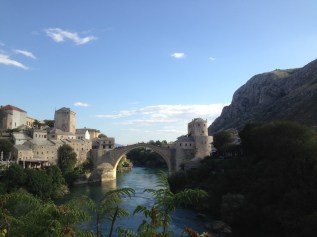 By 2004 with the reconstruction of the Old Bridge (Stari Most) things started to improve for the city and for her family. In the same year her sister gave her an apartment to rent to tourists on the westside, she explained how she would wait at the bus station for tourists and offer them this accommodation.
One day while waiting she met a lady from New Zealand and they hosted her in their own home. It turned out the lady was actually a tourist guide and she encouraged Beba to set up a website and promote the hostel. Soon after she invested in a computer and every year the same lady would send people to visit the hostel.
Beba spoke freely about her experience and then while listening to my friend translate my questions there was a little laughter from her, I asked why she was laughing and they explained that they were talking about a book she discovered in 2008 that really inspired her and gave her further determination to fulfil her ambition to build her home and make the hostel a successful business.
To my surprise she was referring to the book “The Secret” a book my own mother has read and found inspiring. I started to laugh too because she then explained that she had tried to get others to read the book but they thought she crazy because a book could not bring empowerment.
In 2008 things again started to positively change for the business, they received a traveller from France who went on to leave a positive comment on facebook about his time with Beba and her family, which then followed a series of further positive comments and recommendations from other guests.
Beba spoke of the funny memories too, like when she served guests breakfast out in the garden and the table would wobble because of a hole in the ground still remaining from the conflict and their old car that looked like it was falling apart yet it still managed to get them around and take guests on tours.
I must have spent over two hours speaking with Beba on that sunning afternoon and I could have spent many more hours with her talking. I ended our conversation by asking what would she say to future women in Mostar? She replied “people can be fake, materialist and just want to make an impression, but this is not what gets you places, people think too you have to be lucky, but you have to work, be active and take what opportunities you can”. Everyone has to get on with life she concluded.
For me Beba is a woman of strength and vision, she is a positive example of the great value women bring to their societies, for Bosnia and Herzegovina a society trying to move away from the effects of conflict her vision and the warm and friendly embrace she gave me and all the other guests who come through her home, serves to help build a tourist industry and economic growth, she is therefore an example of the women who are an economic driving force in Mostar.
 On a personal level my afternoon with Beba has been one of great learning about the effect of conflict on women’s lives. While my talk with her demonstrates that regardless of language and cultural differences no matter where we are in the world at the end of the day we are all human beings who have the ability to form bonds over the simplest of things, which in turn allows us to interact and form dialogue which provides personal grow and wider social understanding.
[1] 2013 PRELIMINARY Census RESULTS http://www.bhas.ba/obavjestenja/Preliminarni_rezultati_bos.pdf [2] http://news.bbc.co.uk/2/hi/europe/6228152.stm [3] (Women, War, and Politics in Bosnia- Herzegovina, Marie E. Berry, UCLA, Research Country: Bosnia- Herzegovina, August, 2013) http://www.irex.org/sites/default/files/Berry%2012-13%20Research%20Brief.pdf


 Unwrapping Conflict